You can foster diversity, inclusion, and belonging in ways that benefit not just your team, but also your entire organization. How? Strengthen your skills in these crucial areas.
Index
- Understand what your organization can do
- Much talk—but still not enough action
- Help create a more diverse organization
- Send the right message when you hire
- Shape a culture of growth and opportunity
- Promote ongoing learning about inequality
1. Understand what your organization can do
Whether or not you manage others, you can do a lot to help your organization reap the benefits of diversity. Those benefits include higher productivity, stronger employee engagement, and smarter decision-making—advantages you get when people bring their whole selves to work.
To foster diversity, inclusion, and belonging in ways that benefit your team and organization, you’ll want to build your skills in these two areas:
- Understand what your organization can do to foster diversity, inclusion, and belonging
- Support your organization’s diversity efforts in your day-to-day work
How organizations respond to distressing events, as well as to the day-to-day indignities that people from minority groups face, can help employees feel psychologically safe—or it can worsen feelings of threat and mistrust.
2. Much talk—but still not enough action
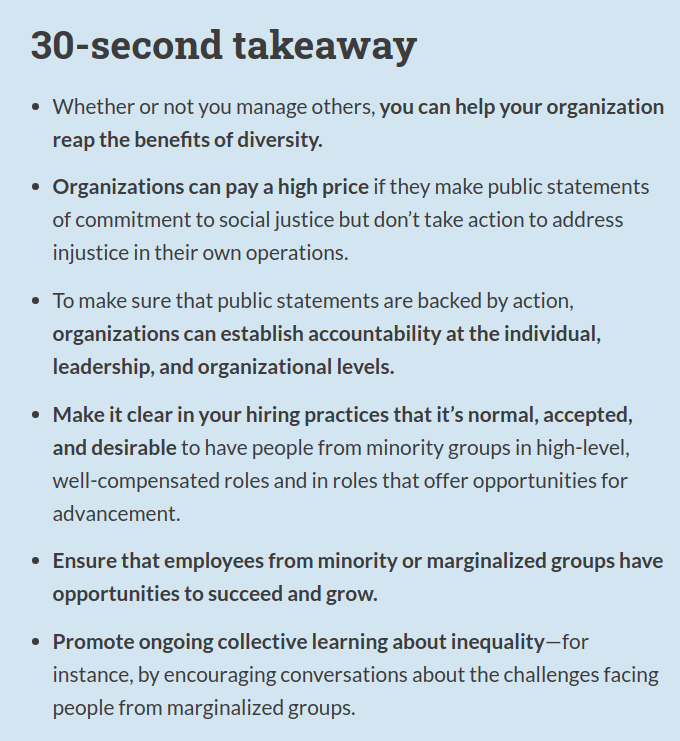
Sometimes, though, an organization can get so caught up in communicating statements of support and solidarity that they neglect to follow up on their commitments. In other words, they fail to take action to address marginalization in their own workforce.
How can organizations follow up on public statements of support for social justice with real action?
They can create accountability at the individual, leadership, and organizational levels.
Here are some examples of how they might do so:
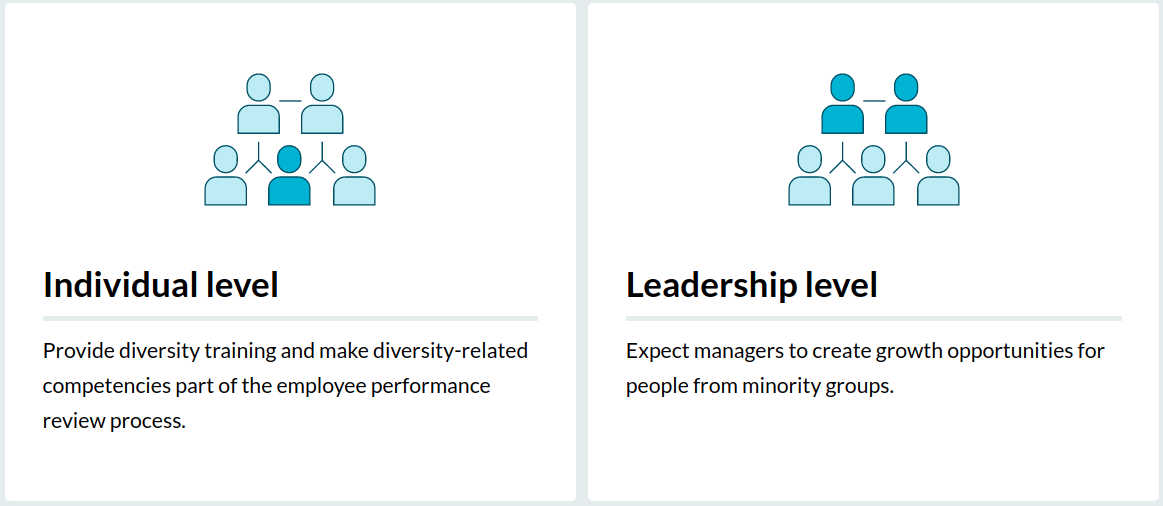
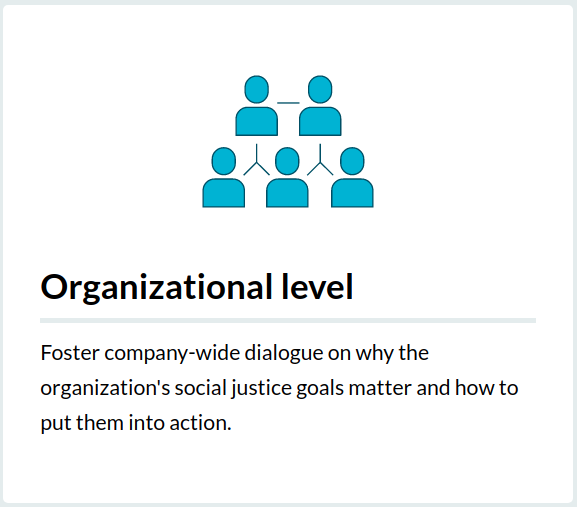
At the organizational level, sponsoring Employee Resource Groups (ERGs)—membership groups structured around a shared identity, such as gender or race—is one popular way to foster inclusion and a sense of belonging. *
3. Help create a more diverse organization
Creating a diverse and inclusive organization takes work by individuals at every level. As a manager, you can help articulate diversity-related goals, shape initiatives to achieve those goals, and take targeted steps in your own day-to-day work.
Send the right message through your hiring and compensation practices. Whom you hire, at what level, and for what compensation all send a strong message about how employees should be valued.
Shape a culture of growth and opportunity.
Take steps to ensure that employees from minority or marginalized groups have opportunities to succeed and grow. Here are some ideas:
Regularly check in about their professional goals and how you can help them achieve them.
Provide specific, actionable feedback on how they can further develop their skills.
Tell influential people in your organization about their expertise, accomplishments, and potential.
Introduce them to others in the organization who can further help them grow.
Promote ongoing, collective learning about inequality.
To enable ongoing, collective learning about the impacts of marginalization, you don’t have to make big, showy efforts. In fact, if you’re open to them, learning opportunities can present themselves even as you go about your everyday activities.
You can initiate seemingly small but powerful changes in how you and members of your team interact with others in the workplace—and can make sure everyone feels a sense of belonging. After all, it’s the little moments each day that determine whether inclusion does—or doesn’t—happen.
Consider these ideas for making the most of those moments: *
- Forge relationships
- Get people to spend time with team members who appear to be different from themselves or whom they don’t know well.
- The resulting relationships will boost the odds that, during discussions about gender, race, ethnicity, and other types of differences, people will assume that everyone involved has positive intentions.
- Hint: Put this idea into practice for yourself by spending more time with peer managers who are different from you.
- Start talking
- Encourage conversations about the challenges and concerns facing people from minority or marginalized groups.
- Acknowledge that these conversations can get emotional and that missteps will happen.
- Lead by example by demonstrating a genuine interest in the diverse experiences and perspectives that each participant brings to these conversations.
- Don’t assume that all people in a particular minority or marginalized group have the same experiences or views. Honor their uniqueness by asking them about their individual experiences and perspectives.
- Seize the moment
- Call out inappropriate or exclusionary behaviors or comments, especially those happening in informal interactions.
- Explain one-on-one to the perpetrator how their behavior marginalizes other employees—whether they intended it to or not.
- Explain how the team overall is hurt by this behavior.
- With your team, describe what happened and explain what will change as a result.
- Avoid common mistakes
- If diversity-related violence receives significant media attention, resist any temptation to keep silent about it. Instead, recognize that no one has the perfect words to address atrocities in society.
- Then, convey care and concern for people in your team who belong to the minority or marginalized groups discussed in the news.
- Watch for any impulse to conclude that victims must have done something to deserve the abuse inflicted on them—that’s a common, and highly destructive, cognitive bias.
- Measure progress
Regularly ask your team members how they think things are going. What barriers are they facing? How might those barriers be removed so they can get access to important opportunities and bring their whole selves to work?
See if your organization conducts employee engagement surveys in which data is broken out by criteria such as gender, race, and ethnicity. If it does, review the data. The findings can signal the need for everyone to step up their inclusion efforts.