Bias and privilege can hinder a team’s efforts to foster and benefit from diversity. Learn to manage these factors—and help turn diversity into a powerful enabler of success for your team and organization.
Index
- Factors that erode diversity’s power
- What is bias?
- Interrupt your biases
- What is privilege?
- 4.1 The many forms of privilege
- Use your privilege to become an ally
1. Factors that erode diversity’s power
To be fully engaged, motivated, and productive, each member of the organization must feel welcomed and included in the team’s efforts, be willing to learn from one another’s differences, and be able to bring their whole, authentic self to work.
But there are two key factors that can prevent you, your team, and your organization from reaping diversity’s benefits: bias and privilege.
2. What is bias?

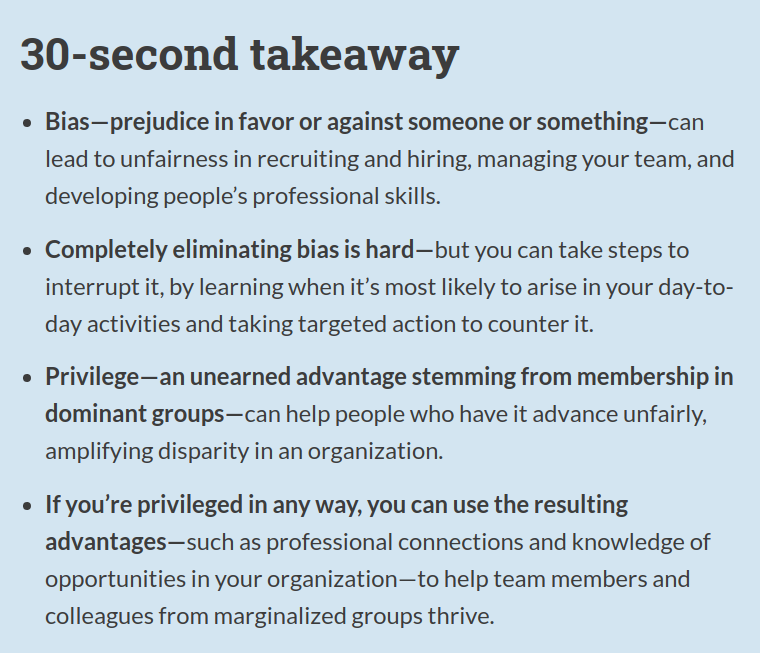
A bias is a prejudice in favor of or against a thing, person, or group compared with another — usually in an unfair or negative way.
Having biases is part of being human—they may even be hardwired in our brains or reinforced by exposure to societal messages. Still, with effort and intention, we can interrupt our biases—once we understand how they work and learn how to recognize and diffuse them.
Most important, biases often lie outside our conscious awareness: We don’t know we have them. For that reason, they are often described as “unconscious” or “implicit.”
Common biases include:
- Affinity bias :
The tendency to warm up to people who are similar to ourselves; favoring those who have things in common with us.
If the person I have to write an evaluation of is someone who graduated from my alma mater, I may rate them much higher than the person with whom I have little or no connection. Unconsciously, the person with whom I have a perceived affinity will automatically have an edge over the others whether they deserve it or not.
Possible solutions:
- Create standard processes that will help you to pause before you react in favor of, or to the detriment of someone in a review process.
- Working off a structure that you can apply to everyone will help to lessen the influence of bias in your decision making processes.
- Standardization also slows down the process so that your automatic and unconscious gut reaction can be replaced with methodical and deliberate action.
- Confirmation bias :
Seeking out evidence that confirms our initial perceptions, ignoring contrary information.
For example, let’s say Megha has an idea for a new product. She does market research and presents findings that support her initial idea. When I, her co-worker present data that shows the product won’t be profitable, Megha discounts it. Megha has data, I have data, and both of us believe our data proves the point. Confirmation bias becomes a problem when Megha pushes the product to market, based solely on her data.
Possible solutions:
- Look for data that disproves your point, and ask for others to review your conclusions.
- develop standard system of evaluation
- get your work regularly reviewed
- Perception bias (stereotypes) :
Tendency to form stereotypes and assumptions about certain groups that makes it difficult to make an objective judgment about individual members of those groups.
For example, there is an assumption that men are better suited to science and technology-related projects than women. So how does this affect women? Our experience has shown us that men work in these roles, not women, so we gravitate towards the perception we’re used to.
If the bias is based on a stereotype rather than fact, the act of overlooking underrepresented groups of people will continue.
Possible solutions:
- acknowledging the problem exists,
- ensuring there is widespread awareness of it,
- resolving to do something about it,
- becoming accountable for your actions.
3. Interrupt your biases

Biases can lead to exclusion and other forms of unfairness in common workplace situations. These include how a manager handles team dynamics and conflict, and develops people.
It’s hard to completely eliminate biases, but you can take steps to interrupt them. To do that, you need to understand when they are most likely to arise in your day-to-day activities and what you can do to counteract them.
Manage day to day : Create and enforce a policy to prevent members of dominant groups from being overly controlling during meetings. If some people are holding back their thoughts or speaking in a tentative, deferential way, invite them to weigh in.
Develop your team : Clarify performance evaluation criteria and focus on individual team members’ actual performance, not their potential.
Document specifics about why you think someone deserves a promotion. For instance, “He writes clear, concise executive summaries under tight deadlines,” not “He writes well.”
In performance assessments, focus on skills, not personality: “She’s a strong collaborator,” not “ She gets along with everyone.”
Counteract any tendency toward modesty among some groups by making it clear that you expect everyone to advocate for themselves.
Privilege, on the other hand, is something you can’t remove or eliminate; rather, it’s what you do with privilege that matters most.
4. What is privilege?

Privilege is an unearned, sustained advantage that comes from race, gender, sexuality, ability, socioeconomic status, age, and other factors.
Privilege is closely connected to bias. How? Just as bias can hold people back unfairly, privilege can help people advance unfairly.
It’s not that people with privilege don’t work hard; it’s that privilege serves as an accelerator that lets some people pursue their dreams more easily than their peers who aren’t privileged.
The injustice that comes with privilege is made even worse when people deny that they have privilege or aren’t aware of it. Under those conditions, they have difficulty seeing how they can use their advantages to help others thrive. The power of privilege is thus wasted, which is the real problem.
4.1 The many forms of privilege
Depending on where you live and work, some forms of privilege are taken for granted, because most people in that society or organization share them.
People who have privilege may not recognize the benefits that come with it. They also may feel little need to protect themselves from bias, because it’s safe belonging to dominant groups.
What’s more, people with privilege might have difficulty seeing how a lack of privilege affects others. So, they may not notice how less privileged individuals in their personal and professional lives are being excluded and marginalized.
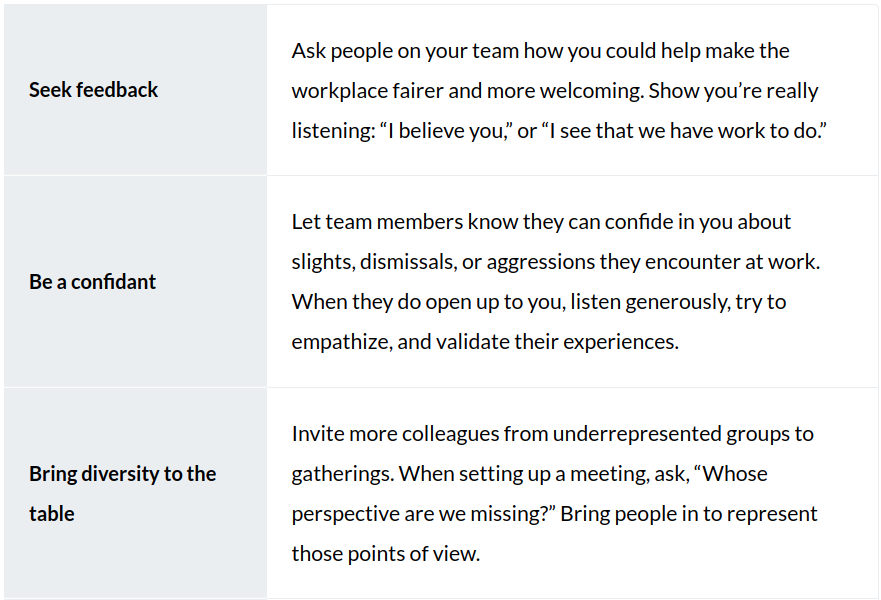
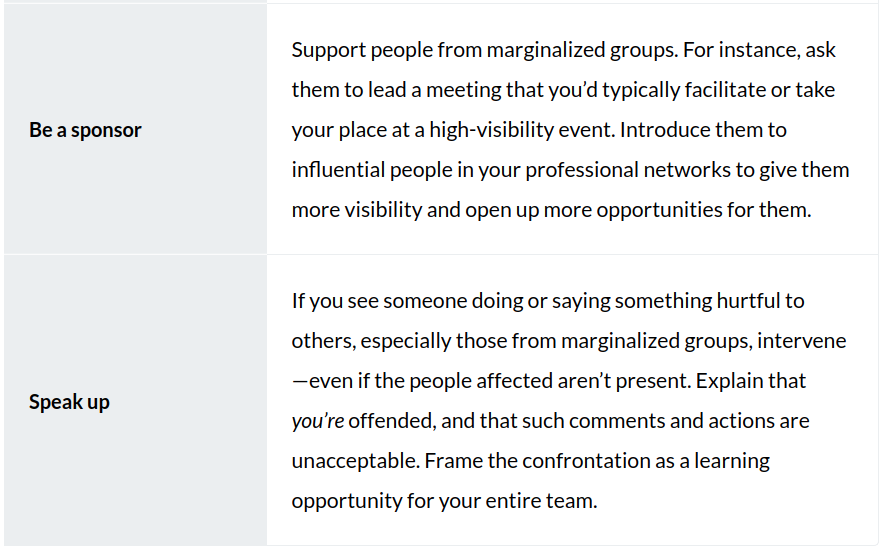
5. Use your privilege to become an ally

You can become an ally — someone who promotes equity and inclusion through supportive relationships and public acts of sponsorship and advocacy. Try these best practices for allyship: